B'NAI ELIM

B'NAI ELIM
Children of the Mighty

B'nai Elim Blogmaster's Disclaimer

Please note: The Blogmaster of this Blog is retired from B’nai Elim and was their former International Chairman and Chief of Intelligence and Security. Prior to forming B’nai Elim, he was a long time member and became the International Chairman of the Jewish Defense League, succeeding Irv Rubin (OBM) to that post. The items posted in this Blog do not necessarily reflect the opinions of B’nai Elim or its members and are the sole responsibility of the Blogmaster, Velvel ben Moshe, aka: Bill Maniaci who is currently the Director of "The Maccabee Group" doing Independent Intelligence Consulting & Analysis.

Set Your Watch with B'nai Elim Jerusalem Time

Jerusalem On Line - Channel 2 News from Israel

UN Doomsday Treaty With Ginny Simone

Showing posts with label ISRAEL. PALESTINE. Show all posts

28 October 2009

"PALESTINE" DOES NOT EXIST - NEVER HAS - NEVER WILL

Palestine is a Geographical Area, Not a Nationality

Arabs, the UN and its organs, and lately the International Court of Justice (ICJ) as well, have repeatedly claimed that the Palestinians are a native people - so much so that almost everyone takes it for granted. The problem is that a stateless Palestinian People is a fabrication. The word Palestine is not even Arabic.

Palestine was never an independent state belonging to any people, nor did a Palestinian People distinct from other Arabs appear during 1,300 years of Muslim hegemony in Palestine under Arab and Ottoman rule. During that rule, local Arabs were actually considered part of, and subject to, the authority of Greater Syria (Suriyya al-Kubra).

Historically, before the Arabs fabricated the concept of Palestinian peoplehood as an exclusively Arab phenomenon, no such group existed. This is substantiated in countless official British Mandate-vintage documents that speak of the Jews and the Arabs of Palestine - not Jews and Palestinians.

In fact, before local Jews began calling themselves Israelis in 1948 (when the name "Israel" was chosen for the newly-established Jewish State), the term "Palestine" applied almost exclusively to Jews and the institutions founded by new Jewish immigrants in the first half of the 20th century, before the state's independence.

Some examples include:

· The Jerusalem Post, founded in 1932, was called The Palestine Post until 1948.

· Bank Leumi L'Israel, incorporated in 1902, was called the "Anglo-Palestine Company" until 1948.

· The Jewish Agency - an arm of the Zionist movement engaged in Jewish settlement since 1929 - was initially called the Jewish Agency for Palestine.

· Today's Israel Philharmonic Orchestra, founded in 1936 by German Jewish refugees who fled Nazi Germany, was originally called the "Palestine Symphony Orchestra," composed of some 70 Palestinian Jews.

· The United Jewish Appeal (UJA) was established in 1939 as a merger of the United Palestine Appeal and the fundraising arm of the Joint Distribution Committee.

There Has Never Been a Sovereign Arab State in Palestine

The artificiality of a Palestinian identity is reflected in the attitudes and actions of neighboring Arabs who never established a Palestinian state or advocated one prior to the Six-Day War in 1967.

Only twice in Jerusalem's history has it served as a national capital. The first time was as the capital of the two Jewish Commonwealths during the First and Second Temple periods, as described in the Bible, reinforced by archaeological evidence and numerous ancient documents. The second time is in modern times as the capital of the State of Israel. It has never served as an Arab capital for the simple reason that there has never been a Palestinian Arab state.

The rhetoric by Arab leaders on behalf of the Palestinians rings hollow. Arabs never established a Palestinian state when the UN in 1947 recommended to partition Palestine, and to establish "an Arab and a Jewish state" (not a Palestinian state, it should be noted). Nor did the Arabs recognize or establish a Palestinian state during the two decades prior to the Six-Day War when the West Bank was under Jordanian control and the Gaza Strip was under Egyptian control; nor did the Palestinian Arabs clamor for autonomy or independence during those years under Jordanian and Egyptian rule.

So much for facts and accuracy.
Bookmark and Share

23 September 2009

Peace Process or War Process?


by Daniel Pipes

Middle East QuarterlyFall 2009


When Barack Obama announced in June 2009 about Israeli-Palestinian diplomacy, "I'm confident that if we stick with it, having started early, that we can make some serious progress this year," he displayed a touching, if naïve optimism.


Indeed, his determination fits a well-established pattern of determination by politicians to "solve" the Arab-Israeli conflict; there were fourteen U.S. government initiatives just during the two George W. Bush administrations. Might this time be different? Will trying harder or being more clever end the conflict?


No, there is no chance whatever of this effort working.


Without looking at the specifics of the Obama approach — which are in themselves problematic — I shall argue three points: that past Israeli-Palestinian negotiations have failed; that their failure resulted from an Israeli illusion about avoiding war; and that Washington should urge Jerusalem to forego negotiations and return instead to its earlier and more successful policy of fighting for victory.


I. Reviewing the "Peace Process"

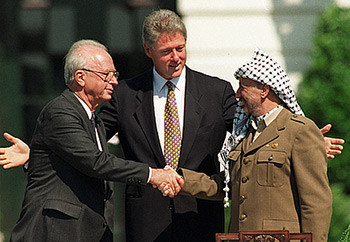
The two hands of September 1993, when Yitzhak Rabin and Yasir Arafat shook hands with President Clinton watching.It is embarrassing to recall the elation and expectations that accompanied the signing of the Oslo accords in September 1993 when Israel's prime minister Yitzhak Rabin shook hands on the White House lawn with Yasir Arafat, the Palestinian leader. For some years afterward, "
The Handshake" (as it was then capitalized) served as the symbol of brilliant diplomacy, whereby each side achieved what it most wanted: dignity and autonomy for the Palestinians, recognition and security for the Israelis.
President
Bill Clinton hosted the ceremony and lauded the deal as a "great occasion of history." Secretary of State Warren Christopher concluded that "the impossible is within our reach." Yasir Arafat called the signing an "historic event, inaugurating a new epoch." Israel's foreign minister Shimon Peres said one could see in it "the outline of peace in the Middle East."
The press displayed similar expectations. Anthony Lewis, a New York Times columnist, deemed the agreement "stunning" and "ingeniously built." Time magazine made Arafat and Rabin two of its "men of the year" for 1993. To cap it off, Arafat, Rabin, and Peres jointly won the Nobel Peace Prize for 1994.

As the accords led to a deterioration of conditions for Palestinians and Israelis, rather than the expected improvement, these heady anticipations quickly dissipated.

When Palestinians still lived under Israeli control, pre-Oslo accords, they had benefited from the rule of law and a growing economy, independent of international welfare. They enjoyed functioning schools and hospitals; they traveled without checkpoints and had free access to Israeli territory. They even founded several universities. Terrorism declined as acceptance of Israel increased. Oslo then brought Palestinians not peace and prosperity, but tyranny, failed institutions, poverty, corruption, a death cult, suicide factories, and Islamist radicalization. Yasir Arafat had promised to build his new dominion into a Middle Eastern Singapore, but the reality he ruled became a nightmare of dependence, inhumanity, and loathing, more akin to Liberia or the Congo.


The two hands of October 2000, when a young Palestinian showed off his bloody hands after lynching two Israeli reservists.
As for Israelis, they watched as Palestinian rage spiraled upward, inflicting unprecedented violence on them; the Israeli Ministry of Foreign Affairs reports that more Israelis were killed by Palestinian terrorists in the five years after the Oslo accords than in the fifteen years preceding it. If the two hands in the Rabin-Arafat handshake symbolized Oslo's early hopes, the two bloody hands of a young Palestinian male who had just lynched Israeli reservists in Ramallah in October 2000 represented its dismal end. In addition, Oslo did great damage to Israel's standing internationally, resurrecting questions about the very existence of a sovereign Jewish state, especially on the Left, and spawning moral perversions such as the U.N. World Conference against Racism in Durban. From Israel's perspective, the seven years of Oslo diplomacy, 1993-2000, largely undid forty-five years of success in warfare.

Palestinians and Israelis agree on little, but with a near universality they concur that the Oslo accords failed. What is called the "peace process" should rather be called the "war process."
II. The False Hope of Finessing War

Why did things go so badly wrong? Where lay the flaws in so promising an agreement?

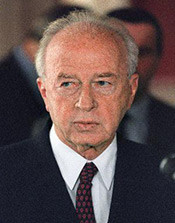
Yitzhak Rabin's understanding that "One does not make peace with one's friends. One makes peace with one's enemy" led Arab-Israeli diplomacy fundamentally astray.Of a multiplicity of errors, the ultimate mistake lay in Yitzhak Rabin's misunderstanding of how war ends, as revealed by his
catch-phrase, "One does not make peace with one's friends. One makes peace with one's enemy." The Israeli prime minister expected war to be concluded through goodwill, conciliation, mediation, flexibility, restraint, generosity, and compromise, topped off with signatures on official documents. In this spirit, his government and those of his three successors — Shimon Peres, Binyamin Netanyahu, Ehud Barak — initiated an array of concessions, hoping and expecting the Palestinians to reciprocate.


Yitzhak Rabin's understanding that "One does not make peace with one's friends. One makes peace with one's enemy" led Arab-Israeli diplomacy fundamentally astray.


They did not. In fact, Israeli concessions inflamed Palestinian hostility. Palestinians interpreted Israeli efforts to "make peace" as signals of demoralization and weakness. "Painful concessions" reduced the Palestinian awe of Israel, made the Jewish state appear vulnerable, and incited irredentist dreams of annihilation. Each Oslo-negotiated gesture by Israel further exhilarated, radicalized, and mobilized the Palestinian body politic to war. The quiet hope of 1993 to eliminate Israel gained traction, becoming a deafening demand by 2000. Venomous speech and violent actions soared. Polls and votes in recent years suggest that a mere 20 percent of Palestinians accept the existence of a Jewish state.

Rabin's mistake was simple and profound: One cannot "make peace with one's enemy," as he imagined. Rather, one makes peace with one's former enemy. Peace nearly always requires one side in a conflict to be defeated and thus give up its goals.

Wars end not through goodwill but through victory. "Let your great object [in war] be victory" observed Sun Tzu, the ancient Chinese strategist. "War is an act of violence to compel the enemy to fulfill our will," wrote his nineteenth-century Prussian successor, Karl von Clausewitz in 1832. Douglas MacArthur observed in 1951 that in "war, there is no substitute for victory."

Technological advancement has not altered this insight. Fighting either continues or potentially can resume so long as both sides hope to achieve their war goals. Victory consists of imposing one's will on the enemy, compelling him to give up his war ambitions. Wars typically end when one side gives up hope, when its will to fight has been crushed.

Defeat, one might think, usually follows on devastating battlefield losses, as was the case of the Axis in 1945. But that has rarely occurred during the past sixty years. Battlefield losses by the Arab states to Israel in 1948-82, by North Korea in 1953, by Saddam Hussein in 1991, and by Iraqi Sunnis in 2003 did not translate into despair and surrender. Morale and will matter more these days. Although they out-manned and out-gunned their foes, the French gave up in Algeria, the Americans in Vietnam, and the Soviets in Afghanistan. The Cold War ended, notably, with barely a fatality. Crushing the enemy's will to fight, then, does not necessarily mean crushing the enemy.

Arabs and Israelis since 1948 have pursued static and opposite goals: Arabs fought to eliminate Israel; Israelis fought to win their neighbors' acceptance. Details have varied over the decades with multiple ideologies, strategies, and leading actors, but the twin goals have remained in place and unbridgeable. If the conflict is to end, one side must lose and one side win. Either there will be no more Zionist state or it will be accepted by its neighbors. Those are the only two scenarios for ending the conflict. Anything else is unstable and a premise for further warfare.

The Arabs have pursued their war aims with patience, determination, and purpose; the exceptions to this pattern (e.g., the Egyptian and Jordanian peace treaties) have been operationally insignificant because they have not tamped hostility to Israel's existence. In response, Israelis sustained a formidable record of strategic vision and tactical brilliance in the period 1948-93. Over time, however, as Israel developed into a wealthy country, its populace grew impatient with the humiliating, slow, boring, bitter, and expensive task of convincing Arabs to accept their political existence. By now, few in Israel still see victory as the goal; almost no major political figure on the scene today calls for victory in war. Uzi Landau, currently minister of national infrastructure, who argues that "when you're in a war you want to win the war," is the rare exception.

The Hard Work of Winning

*In place of victory, Israelis developed an imaginative array of approaches to manage the conflict:
*Territorial compromise: Yitzhak Rabin (and the Oslo process).
*Develop the Palestinian economy:
Shimon Peres (and the Oslo process).
*Unilateralism (build a wall, withdraw from Gaza): Ariel Sharon, Ehud Olmert, and the Kadima party.
*Lease the land under Israeli towns on the West Bank for 99 years: Amir Peretz and the Labor Party.
*Encourage the Palestinians to develop good government: Natan Sharansky (and George W. Bush).
*Territorial retreat: Israel's Left.
*Exclude disloyal Palestinians from Israeli citizenship: Avigdor Lieberman.
*Offer Jordan as Palestine: elements of Israel's Right.
*Expel Palestinians from lands controlled by Israel: Meir Kahane.


Contradictory in spirit and mutually exclusive as they are, these approaches all aim to finesse war rather than win it. Not one of them addresses the need to break the Palestinian will to fight. Just as the Oslo negotiations failed, I predict that so too will every Israeli scheme that avoids the hard work of winning.

Ehud Olmert speaking for the Israel Policy Forum in June 2005, where he announced that Israelis "are tired of fighting, we are tired of being courageous, we are tired of winning, we are tired of defeating our enemies."Since 1993, in brief, the Arabs have sought victory while Israelis sought compromise. In this spirit, Israelis openly announced their fatigue with warfare. Shortly before becoming prime minister,
Ehud Olmert said on behalf of his countrymen: "We are tired of fighting; we are tired of being courageous; we are tired of winning; we are tired of defeating our enemies." After becoming prime minister, Olmert proclaimed: "Peace is achieved through concessions. We all know that." Such defeatist statements prompted Yoram Hazony of the Shalem Center to characterize Israelis as "an exhausted people, confused and without direction."

But who does not win, loses. To survive, Israelis eventually must return to their pre-1993 policy of establishing that Israel is strong, tough, and permanent. That is achieved through deterrence — the tedious task of convincing Palestinians and others that the Jewish state will endure and that dreams of elimination must fail.
This will not be easy or quick. Due to missteps during the Oslo years and after (especially the unilateral withdrawal from Gaza of 2005 and the Lebanon war of 2006), Palestinians perceive Israel as economically and militarily strong but morally and politically weak. In the pungent words of Hezbollah leader Hassan Nasrallah, Israel is "weaker than a spider's web." Such scorn will likely require decades of hard work to reverse. Nor will it be pretty: Defeat in war typically entails that the loser experience deprivation, failure, and despair.

Israel does enjoy one piece of good fortune: It need only deter the Palestinians, not the whole Arab and Muslim populations. Moroccans, Iranians, Malaysians, and others take their cues from the Palestinians and with time will follow their lead. Israel's ultimate enemy, the one whose will it needs to crush, is roughly the same demographic size as itself.

This process may be seen through a simple prism. Any development that encourages Palestinians to think they can eliminate Israel is negative, any that encourages them to give up that goal is positive.

The Palestinians' defeat will be recognizable when, over a protracted period and with complete consistency, they prove that they have accepted Israel. This does not mean loving Zion, but it does mean permanently accepting it — overhauling the educational system to take out the demonization of Jews and Israel, telling the truth about Jewish ties to Jerusalem, and accepting normal commercial, cultural, and human relations with Israelis.

Palestinian démarches and letters to the editor are acceptable but violence is not. The quiet that follows must be consistent and enduring. Symbolically, one can conclude that Palestinians have accepted Israel and the war is over when Jews living in Hebron (on the West Bank) have no more need for security than Arabs living in Nazareth (in Israel).

III. U.S. Policy

Like all outsiders to the conflict, Americans face a stark choice: Endorse the Palestinian goal of eliminating Israel or endorse Israel's goal of winning its neighbors' acceptance.

To state the choice makes clear that there is no choice — the first is barbaric, the second civilized. No decent person can endorse the Palestinians' genocidal goal of eliminating their neighbor. Following every president since Harry S Truman, and every congressional resolution and vote since then, the U.S. government must stand with Israel in its drive to win acceptance.

Not only is this an obvious moral choice, but Israel's win, ironically, would be the best thing that ever happened to the Palestinians. Compelling them finally to give up on their irredentist dream would liberate them to focus on their own polity, economy, society, and culture. Palestinians need to experience the crucible of defeat to become a normal people — one whose parents stop celebrating their children becoming suicide terrorists, whose obsession with Zionist rejectionism collapses. There is no shortcut.

This analysis implies a radically different approach for the U.S. government from the current one. On the negative side, it puts Palestinians on notice that benefits will flow to them only after they prove their acceptance of Israel. Until then — no diplomacy, no discussion of final status, no recognition as a state, and certainly no financial aid or weapons.

On the positive side, the U. S. administration should work with Israel, the Arab states, and others to induce the Palestinians to accept Israel's existence by convincing them that they have lost. This means impressing on the Israeli government the need not just to defend itself but to take steps to demonstrate to Palestinians the hopelessness of their cause. That requires not episodic shows of force (such as the 2008-09 war against Hamas in Gaza) but a sustained and systematic effort to deflate a bellicose mentality.

Israel's victory also directly helps its U.S. ally, for some of its enemies — Hamas, Hezbollah, Syria, and Iran — are also America's. Tougher Israeli tactics would help Washington in smaller ways, too. Washington should encourage Jerusalem not to engage in prisoner exchanges with terrorist groups, not to allow Hezbollah to re-arm in southern Lebanon or Fatah or Hamas in Gaza, and not to withdraw unilaterally from the West Bank (which would effectively turn over the region to Hamas terrorists and threaten Hashemite rule in Jordan).

Diplomacy aiming to shut down the Arab-Israeli conflict is premature until Palestinians give up their anti-Zionism. When that happy moment arrives, negotiations can re-open and take up anew the Oslo issues — borders, resources, armaments, sanctities, residential rights. But that is years or decades away. In the meantime, an ally needs to win.

Daniel Pipes is publisher of the Middle East Quarterly and Taube distinguished visiting fellow at the Hoover Institution of Stanford University.

Related Topics: Arab-Israel conflict & diplomacy receive the latest by email: subscribe to daniel pipes' free mailing list
Bookmark and Share

06 July 2009

Arab “night sweats ”

The Arab World's New Conspiracy Theory

July 6, 2009 6:30 AMby Dan Diker Journalist

Prime Minister Binyamin Netanyahu’s recent policy speech at Bar Ilan University in which he underscored Israel’s character as a Jewish State and beseeched the Palestinian Authority to recognize the Jewish State has triggered a fast spreading rumor in Arab capitals. They are convinced of an Israeli government plot to cancel the Israel’s Arab minority right to vote as part of a larger plan to transfer Arabs eastward to the West Bank and even to Jordan.

Two Arab diplomats spoke separate meetings this past week of their fear that Netanyahu’s determination to ensure Israel’s Jewish character would result in Israel’s renunciation of the political rights of Israeli’s Arab minority. A Middle East based US diplomat confirmed the Arab fears, noting he has received emails and phone calls. The roots of this complete Arab misconception of Israel’s Jewish character may reveal less about Israel and more about Arab and Muslim political culture.

Arab colleagues noted that the Islamic Republic of Iran, and not their own Sunni Arab Muslim states, was the model for what they estimated Israel would emulate to ensure its Jewish character. Netanyahu, they reasoned, would surely not have mentioned Israel’s Jewish character half a dozen times in the June 15th Bar Ilan speech had he merely intended to refer to its current identity as a Jewish and democratic state. Rather, they asserted, he would necessarily sacrifice Israel’s democracy to assert its Jewish “DNA”, just as Iran’s Ayatollah Ali Khamenei’s “mullocratic” enforced Sharia law as the shaper of Iran’s Islamic character.

It was a virtually impossible task to explain to Arab friends that Netanyahu’s emphasis of Israel as a Jewish and democratic state reflects the continuation of the state as it is today, and does not foretell radical changes to its free and democratic character. Israel is, in fact, the only state in the Middle East whose laws guarantee democratic freedoms and civil rights for all minorities.

“That is the point!” they retorted. “Israeli government ministers have spoken recently of Israeli Arab civil rights and purposely ignore mentioning Arab political rights. To them, this meant that Israel was about to rescind the Arab Minority’s right to vote. The election fraud in Iran provided the recent psychological context. The growing Arab suspicion is that the apparent focus on civil rights and omission of “political rights” in statements by Israeli leaders prophesied another looming disaster- a political Nakba -for Israeli Arabs. Add to this Foreign Minister Avigdor Lieberman’s demand for all Israelis to pledge allegiance to the flag, and his suggestion that Israel redraw its map and swap heavily populated Arab towns in northern Israel for Jewish settlements in Judea and Samaria (West Bank), and fears are fed of a larger Israeli conspiracy to carry out a major population Arab transfer.

While all this may seem silly, it is gaining traction in Arab circles; moreover, Israeli leaders have been completely unaware of what is percolating. This week Arab fears were inadvertently ratcheted up a notch. In an off-record briefing, a senior Israeli government official spoke of protecting Israel Arab “civil rights” in the Jewish state while denying Arab “national” rights such as supporting enemy groups such as Hizbullah in Israel.

The senior official also neglected to mention the notion of Arab political rights. When pressed on the omission, he clarified that these clearly included political rights to vote and participate in Israeli Arab political parties that Arab and Druse citizens of Israel have long enjoyed in Israel. In fact, an Arab MK Ghaleb Majadle, served as Minister of Sport and Culture in the previous Olmert government while Arab MK Dr Ahmad Tibi, a former advisor to Yasser Arafat, served as a deputy Knesset speaker.

But Arab diplomats have remained unconvinced that Israeli Arabs are politically secure in Israel. And now they believe the Israeli plot has a new dimension. They have begun to weave the Jewish State conspiracy against Israeli Arabs to a larger Israeli plan to transfer West Bank Arabs to Jordan.

As proof, they point to Israel’s erection of the anti-terror fence in the West Bank as well last month’s Knesset’s approval of a preliminary agenda item brought by Dr. Arye Eldad of the conservative National Union party that proposes Jordan as the Palestinian state.

The proposal passed by a healthy margin of 53 to 7. The surprise approval relied on Likud and right wing votes but also included support from Defense Minister Ehud Barak and five other members of his Labor party. Even five members of Kadima, the main opposition party, also voted in favor of the “Jordan is Palestine” proposal. The resolution had no legislative meaning; it was merely raised as part of the day’s call to order. Analysts further attributed the unexpected support by left wing parties to the result of reigning confusion in the plenum due to the scores of bills up for vote.

However, this did not help Israel’s Ambassador to Jordan, Yaakov Rosen, who was immediately summoned to the Jordanian Foreign Ministry to explain why it appeared to Jordan that Israel is still embracing the “Jordan is Palestine” solution as the alternative homeland for Palestinians.

These latest Arab “night sweats ” over Netanyahu’s re-branding Israel’s Jewish identity suggest that his strategy may be a very appropriate one in the context of Middle Eastern political culture, where conspiracy theories between Arab states are as common as hummus and pita bread. That means Israel is back in the Middle East clubhouse. The upside for Israel of political conspiracy chatter is that it also inspires a healthy dose of fear and uncertainty among otherwise overconfident neighbors.

In hindsight, Israeli Concessions to Palestinians at Oslo I, Oslo II Camp David, the Road map, the Gaza withdrawal, and the Annapolis peace process have severely debilitated Israel’s reputation among other Arab neighbors. Since 1993 and Oslo, the Arab world has increasingly seen Israel as the “kid on the run,” weak, and unsure of its rights. Israel’s premature withdrawals from Gaza and Lebanon before winning those wars, launched upon it by Iran and its proxies, further intensified this view.

Netanyahu’s asserting Israel’s ancient Jewish identity, its rights and non-negotiable security requirements, while extending a hand of compromise to regional leaders, represents a firm step forward for Israel to recover its position of strength as a central regional player. Arab conspiracy chatter also indicates that they know well that the Jewish State is the only unofficial member of the Middle East Arab clubhouse that has been willing to get bloody fighting Iran and its proxies and if necessary, is prepared to do it again.

Bookmark and Share

07 April 2009

THE "REAL" TWO-STATE SOLUTION

Hudson New York
How to Build a Palestinian State

The words and deeds of many Palestinian officials, whether they are from Fatah or Hamas, do not seem to be bringing the Palestinians closer to fulfilling their aspiration of creating a modern and democratic state next to Israel.
In this regard, the Palestinian Authority leaders in the West Bank are continuing to act [and speak] in a way that only radicalizes Palestinians and demonizes Israel and the Jewish people.
Preparing for statehood is not only about building infrastructure and institutions; it is also about educating the people about the importance of living in peace with your neighbors and respecting their right to live insecurity.
Almost every day, the Palestinian Authority, which is dominated by the secular Fatah faction, provides the world with evidence that it is not leading its constituents toward the path of moderation and co-existence. And this is without mentioning what Hamas is saying and doing.
If the Palestinians were serious about building their own state, they should not wait for Israel or any other country to present it to them as a gift.
Had the Palestinian Authority invested perhaps half of the money that went into Yasser Arafat’s secret bank accounts or to support the shopping sprees of his wife in Paris, it is highly likely that the Palestinians would by now have had their own state.
Had the Palestinian leadership built schools, hospitals, universities and housing projects instead of building a casino, there is no doubt that the Palestinians would have had their state several years ago.
Had the Palestinian Authority invested some of the billions of dollars for the welfare of its people, combating poverty and unemployment, it is certain that the Palestinians would not have resorted to violence in September 2000. That is because when the Palestinians launched the second intifada, many people had nothing to lose.
So has the Palestinian Authority since learned from its mistakes?
No.
While it is true that the economic situation in the West Bank has improved in the past two years, largely thanks to the fact that the international donors have finally begun holding Palestinian leaders accountable and are pressing harder for transparency, the messages coming out of the Palestinian leadership are not encouraging.
In the past week alone, the “moderate” Palestinian leadership of President Mahmoud Abbas took two decisions that will only have a negative impact on the future of the “peace process.”
First, Abbas’s representatives dismantled a Palestinian teenager musical band for performing in front of Holocaust survivors in the Israeli city of Holon. An Israeli-Arab woman who was in charge of the ban has been told by Abbas’s lieutenants that her life would be in danger if she ever showed her face again in Jenin. Fatah activists later sealed her apartment and confiscated all the musical equipment, accusing her of “exploiting” the children for a “political event” - the Holocaust.
In the second case, Abbas’s Chief Islamic Judge, Tayseer Tamimi, issued another fatwa [religious decree] that imposes the death sentence on any Palestinian who sells his lands to Jews.
And then there is Mohammed Dahlan, one of Fatah’s senior operatives who is closely associated with Abbas, who went on Palestine TV to proudly declare that his faction has never recognized Israel’s right to exist.
He also boasted that as a former security commander he and Fatah had killed more suspected Palestinian “collaborators” with Israel than Hamas.
Dahlan, who has long been hailed by US Administration officials as a “moderate” leader and a staunch supporter of the peace process, even went as far as urging Hamas not to succumb to pressure to accept Israel’s right to exist.
The Palestinian leadership in the West Bank has also been fighting “normalization” with Israel by boycotting Israeli products and banning Palestinian teenagers from participating in joint Jewish-Arab events aimed at promoting tolerance and coexistence.
It is no wonder then that public opinion polls continue to show that Hamas’s popularity is on the rise and that a majority of Palestinians support suicide bombings.
Over the past few weeks, numerous Palestinian spokesmen have been warning against the “dangers” of having a right-wing government in Israel. According to these spokesmen, the rise of Netanyahu and Foreign Minister Avigdor Lieberman to power is an indication of the Israeli public’s shift to the right and the beginning of the end of the “peace process.”
The Palestinian officials say they are particularly worried about Netanyahu’s refusal to accept the two-state solution.
But were these folks expecting? That Netanyahu and Lieberman would give them more than what former prime ministers Ehud Olmert, Ehud Barak, Shimon Peres, Ariel Sharon and Yitzhak Rabin had either given the Palestinians or offered to give them?
There is absolutely no reason why Israeli Prime Minister Benjamin Netanhayu should be worried about American and European pressure on him to accept the two-state solution.
Even if Netanyahu accepted the two-state solution tomorrow, he will quickly discover that the Palestinian Authority in particular and the Palestinians in general are the least prepared for establishing an independent and normal state alongside Israel.
Netanyahu and Lieberman can sit relaxed. Even if they offered the Palestinians a state, they will discover that there is no credible partner, neither in Ramallah nor in the Gaza Strip, to deal with.
Finally, the failure of the Hamas-Fatah “reconciliation” talks means that the world will have to live with the fact that the two-state solution has already been realized. In the end, the Palestinians got two states - a mini-Islamic republic in the Gaza Strip and an incompetent, powerless and unreliable entity in parts of the West Bank.
Bookmark and Share

Colonel Richard Kemp, British Army - Comment on the IDF's Actions in Gaza

Radical Islams Plans for Western Civilization

THE THIRD JIHAD - WATCH THIS IMPORTANT FILM NOW - FREE

Obama's true agenda...Throw Israel Under the Bus

****Regarding Obama’s Speech before the U.N. Obama has surpassed the peanut farmer Jimmy Carter as the worst and most anti-Israel, anti-Semitic, Arabist President who has ever occupied the White House. Not only is he is a narcissistic moron who is dragging America into an abyss; Obama is the most dangerous threat to World Freedom, Liberty and Western Civilization since Hitler. (Blogmaster)

Senator Joe Leiberman 'Islamist Extremist Regime'

JOHN VOIGHT ON OBAMA'S DISTAIN FOR ISRAEL

CHAZAK CHAZAK

ON THE PATH TO MUSLIM DOMINATION - REVERSABLE? STOPPABLE?

2 STATE SOLUTION - COMMENTARY BY THE "18"

A message to the Jewish people and the entire world

Chronicles I - 16:15-18: "Forever remember His covenant that he commanded forever; That He made with Abraham and swore to Isaac; and confirmed in a decree for Jacob, for Israel, as an eternal covenant; saying to You I will give the Land of Cannan as your alloted heritage"

WE ARE THANKFUL FOR OUR SOLDIERS - G_D BLESS THE IDF

Israel Security Agency

Israel Security Agency
Shin Bet - Protecting Israel's Security 24/7

ISRAEL - WE'RE 60 AND PROUD OF IT!

Jerusalem of Gold, Israel's capital for 3300 years

The Music and Songs of Ofra Haza (OBM)

DON'T MESS WITH THE BEST - IDF GOLAN - ISRAEL

Maccabee Arms Ltd. Products..."LOOK"