
Blogmaster’s Comments on Censorship: Many uninitiated readers are angered by vague and shallow descriptions of the results of rocket attacks against Israeli civilians and towns, as well as the results of a strike against IDF bases and positions. Readers must realize that the enemy views, listens to, and reads all news reports generated by such attacks and can use this information to cause their strikes to be more accurate and successful. Pinpointed and exact locations of rocket hits only serve to help the terrorists achieve more accurate targeting and can cause the loss of Israeli lives. The IDF Censorship Guidelines below are common sense. Loose tongues also cost lives. Remember that Cell Phones are radio transmitters and that anything you say could easily be intercepted by Hamas with only an inexpensive receiver. Be careful when you discuss sensitive information that could help the enemy, be it on the telephone or in a restaurant. Remember that the enemy is listening.
CENSORSHIP GUIDELINES - REPORTING THE LOCATION OF ROCKET HITS
4 March 2008
Background:
Recently, we have witnessed an increase in the number of missiles being
fired from the Gaza Strip into Israel. The missiles themselves are more
accurate and are equipped with stronger, more destructive warheads.
This document emphasizes the censorship guidelines to the media and the
press on the reporting of rocket hits:
Following are the main censorship guidelines:
1. Real-time reports on the exact locations of rocket hits are strictly
prohibited.
Reports, on delayed-time, of exact locations must always be approved by
the IDF Censor.
2. The IDF Censor will not authorize reports of rocket hits at IDF bases
and/or strategic installations.
3. The IDF Censor will not authorize reporting on rockets that fell into the
Mediterranean Sea.
4. The IDF Censor will not authorize photographs of rockets with identifying
marks.
5. The IDF Censor will not authorize reports regarding visits by senior
Israel Government officials and IDF officer in southern Israel.
6. The IDF Censor will not authorize information on exploded terrorist
ordinance or any other malfunctioning ordinance.
7. Panoramic, wide-angle, etc. photographs of rocket hits are strictly
prohibited.
Please ensure that all staff members are aware of the foregoing.
The foregoing does not obviate the obligation to submit to the IDF Censor -
prior to publication - of any news item regarding rocket hits or any other
subject that must be approved by the IDF Censor.
Sincerely,
Col. Sima Vaknin-Gil
Chief Censor to Press and Media
Jerusalem On Line - Channel 2 News from Israel
Showing posts with label ROCKET ATTACKS. Show all posts
Showing posts with label ROCKET ATTACKS. Show all posts
05 March 2008


WHAT SHOULD ISRAEL DO...LIVE OR COMMIT SUICIDE
Nine immoral solutions for Gaza -
a guideBy Bradley Burston
For a moral compass, Gaza is the North Pole. The needle spins so continually, and at such speed, that no reading is possible.
For Israelis, the quandary of Gaza is a powerful Rorshach of the role and the burdens of Israel, of mood and injury, of personal tragedy and official befuddlement, of social conscience, ethical outlook, and sense of history.
The Gaza Strip, unwanted by the world, unwanted by Israel, unwanted by the Arabs and even by many Palestinians, forlorn, violent, seething, unlivable, has become the great moral test for the Jewish people.
All it took was rockets.
Seven years of rockets. Rockets launched toward civilian populations, schools, a college, rockets that slammed through private homes, children's bedrooms in the blue collar Israeli town of Sderot. More than a thousand rockets a year for seven years, directed at kibbutzim which for decades had supported an end to occupation and the rise of a Palestinian state. Eight thousand rockets, fired when Israel had 25 settlements and 20,000 troops in the Gaza Strip, and when Israel expelled the settlers and withdrew its troops, rockets fired from the ruins of the settlements and former emplacements of the IDF.
For Palestinians, Gaza was a prison before the disengagement, and a maximum security lockup thereafter. For Palestinians, the end of Israeli rule and the subsequent rise of Hamas were a human rights tragedy turned human rights catastrophe. For Palestinians, there is no more work in Israel, no more work in Gaza, no more hope anywhere.
When Israel ended its operation in the Strip on Monday, a Hamas radio announcer declared victory, saying that despite all of the destruction and death, Hamas gunners were still hitting Sderot and Ashkelon and even Netivot. Hamas leader Mahmoud Zahar addressed a rally to mark what he called Hamas' success in the Five Day War. Taking the trouble to thank the news media in general for its coverage of Palestinian casualties, Al Jazeera and Hamas' own Al Aqsa TV in particular, he told a cheering, chanting crowd, in effect: We showed them. The Israelis?ll think twice before invading ever again.
He's right. Israelis will think twice, and many times again. This is why: Hamas, with the direct or inadvertent cooperation of Hezbollah, Iran, the Islamic Jihad, Fatah fatcats, Fatah rebels, the Bush administration, and, of course, Israel itself, has created a situation in which every one of Israel's moral and strategic options is a bad one.
This is the test for Israel: There is no way to ace it, and there are countless ways to fail. Here are a few.
Choose your poison:
1. A massive IDF ground offensive.
Arguments in favor: There is no alternative but to use overwhelming if tactically directed force to root out terror groups which fire the rockets, and to break the back of the Hamas government and remove it from power.
Marshalled example: Operation Defensive Shield, 2002
Arguments against: The risk-benefit equation suggests that large numbers of Gaza non-combatants as well as Israeli forces would be killed and wounded, without truly material success in curbing Qassam and Katyusha attacks.
International outrage could cause Israel great political, economic, even strategic harm.
2. Reoccupy the Gaza Strip
Arguments in favor: Israel cannot abide a terrorist state less than an hour's drive from Tel Aviv. Hamas, if allowed to rule, will eventually take over the West Bank and, effectively, East Jerusalem as well. Even a large-scale IDF offensive, if only temporary, will leave the field open to rearmament and continued attacks.
Arguments against: Israel militarily occupied the Gaza Strip for nearly forty years, but was unable to prevent the manufacture and firing of Qassams. Qassam firing continued under Israeli occupation for more than three years until the disengagement in 2005. Finally, Israel lacks the will and the forces to occupy Gaza indefinitely.
3. Shell sources of rocket fire
Arguments in favor: Use of long-range artillery will save the lives of soldiers who would be out at risk in a ground offensive. If Israel puts Gazans on notice that artillery will immediately and consistently shell any area from which rockets are fired, they will either prevent Hamas gunners from using their homes and yards, or will flee before the firing begins.
Arguments against: Artillery has proven markedly inaccurate as retaliatory fire against small crews of armed men, often with disastrous consequences. Cases of innocent civilians killed in error, tragic in themselves, have in many cases also made it impossible for the IDF to continue to pursue its military targets.
4. Assassinate Hamas leaders
Arguments in favor: Assassinations of commanders and political leaders can paralyze the organization, sending leading figures underground, cutting lines of communication, interrupting chains of command, while at the same time causing less danger to Palestinian civilians and to IDF soldiers. When Israel assassinated Hamas founders Sheikh Ahmed Yassin and Abed Aziz Rantisi in 2004, threats os monumental retaliation never materialized, and the organization subsequently offered a limited truce.
Arguments against: Civilians are often killed by mistake in assassination attempts. Assassination is also a dangerous policy, as it invites counter-attempts, such as the murder of then-cabinet minister Rehavam Ze'evi in Jerusalem in 2001. Finally, it fails to address core concerns, and may cause deadly reprisals, as in the suicide bombings that killed 60 people in Israel after the 1996 assassination of Hamas bomb mastermind Yihye Ayyash.
5. Negotiate with Hamas
Arguments for: Hamas is not only the democratically elected ruler of Gaza, it also still enjoys broad, if somewhat dimished, popular support in the Strip. Because it trades on an ideology of martyrdom and steadfastness in the face of attack, it will be defeated neither by economic sanctions nor military confrontation. There is no alternative to talks toward a cease-fire, which Hamas has been proposing for years, holding out the offer of the return of captured IDF soldier Gilad Shalit in an exchange for jailed Hamas men.
Arguments against: Negotiations would constitute a major victory for Hamas, and tacit Israeli recognition of the organization, further undermining the standing of Mahmoud Abbas and the Fatah-led Palestinian Authority and perhaps paving way for future Hamas control of the West Bank.
The Hamas charter continues to call explicitly for the violent destruction of the state of Israel, and any expansion of Hamas hegemony to the West Bank could put large swathes of central Israel, the bulk of Israel's population, in range of Katyusha-Grad rockets.
6. Tighten the economic siege over Gaza
Arguments for: How can a nation at war justify supplying its enemy with fuel, electricity, water, and even supplies which may be used for producing rockets and other armaments?
Arguments against: The people of Gaza as a whole should not be punished for the actions of a small number of armed men. Collective punishment, moreover, increases hatred toward Israel and will, in the end, persuade more youths to become terrorists.
7. Lift the economic siege over Gaza
Arguments in favor: Such a step could, if carried out in cooperation with Abbas and the PA, strengthen Abbas' hand. (Also see arguments against, numbers 6 and, if carried out in cooperation with Hamas, 5 above)
Arguments against: Such a step could bolster Hamas, whioch could list it as a strategic victory and an indication that its policies were correct all along.
8. Increase IDF operations in the West Bank
Arguments in favor: Israel must do everything it can to confront and contain Hamas in the West Bank, to keep it from taking over.
Arguments against: Such operations sap the limited sovereignty of Abbas and the PA, which has taken action of its own against Hamas in the West Bank. Such operations also cast Abbas in the role of collaborator with Israel, cutting his support among Palestinians.
9. Do nothing
Arguments for: This stance, which, while it may have adherents in practice, has no proponents.
Arguments against. Israel does not have the option of doing nothing. To do nothing is, in effect, a violation of the human rights of the people of Sderot and the western Megev, who are the targets of Hamas war crimes.
a guideBy Bradley Burston
For a moral compass, Gaza is the North Pole. The needle spins so continually, and at such speed, that no reading is possible.
For Israelis, the quandary of Gaza is a powerful Rorshach of the role and the burdens of Israel, of mood and injury, of personal tragedy and official befuddlement, of social conscience, ethical outlook, and sense of history.
The Gaza Strip, unwanted by the world, unwanted by Israel, unwanted by the Arabs and even by many Palestinians, forlorn, violent, seething, unlivable, has become the great moral test for the Jewish people.
All it took was rockets.
Seven years of rockets. Rockets launched toward civilian populations, schools, a college, rockets that slammed through private homes, children's bedrooms in the blue collar Israeli town of Sderot. More than a thousand rockets a year for seven years, directed at kibbutzim which for decades had supported an end to occupation and the rise of a Palestinian state. Eight thousand rockets, fired when Israel had 25 settlements and 20,000 troops in the Gaza Strip, and when Israel expelled the settlers and withdrew its troops, rockets fired from the ruins of the settlements and former emplacements of the IDF.
For Palestinians, Gaza was a prison before the disengagement, and a maximum security lockup thereafter. For Palestinians, the end of Israeli rule and the subsequent rise of Hamas were a human rights tragedy turned human rights catastrophe. For Palestinians, there is no more work in Israel, no more work in Gaza, no more hope anywhere.
When Israel ended its operation in the Strip on Monday, a Hamas radio announcer declared victory, saying that despite all of the destruction and death, Hamas gunners were still hitting Sderot and Ashkelon and even Netivot. Hamas leader Mahmoud Zahar addressed a rally to mark what he called Hamas' success in the Five Day War. Taking the trouble to thank the news media in general for its coverage of Palestinian casualties, Al Jazeera and Hamas' own Al Aqsa TV in particular, he told a cheering, chanting crowd, in effect: We showed them. The Israelis?ll think twice before invading ever again.
He's right. Israelis will think twice, and many times again. This is why: Hamas, with the direct or inadvertent cooperation of Hezbollah, Iran, the Islamic Jihad, Fatah fatcats, Fatah rebels, the Bush administration, and, of course, Israel itself, has created a situation in which every one of Israel's moral and strategic options is a bad one.
This is the test for Israel: There is no way to ace it, and there are countless ways to fail. Here are a few.
Choose your poison:
1. A massive IDF ground offensive.
Arguments in favor: There is no alternative but to use overwhelming if tactically directed force to root out terror groups which fire the rockets, and to break the back of the Hamas government and remove it from power.
Marshalled example: Operation Defensive Shield, 2002
Arguments against: The risk-benefit equation suggests that large numbers of Gaza non-combatants as well as Israeli forces would be killed and wounded, without truly material success in curbing Qassam and Katyusha attacks.
International outrage could cause Israel great political, economic, even strategic harm.
2. Reoccupy the Gaza Strip
Arguments in favor: Israel cannot abide a terrorist state less than an hour's drive from Tel Aviv. Hamas, if allowed to rule, will eventually take over the West Bank and, effectively, East Jerusalem as well. Even a large-scale IDF offensive, if only temporary, will leave the field open to rearmament and continued attacks.
Arguments against: Israel militarily occupied the Gaza Strip for nearly forty years, but was unable to prevent the manufacture and firing of Qassams. Qassam firing continued under Israeli occupation for more than three years until the disengagement in 2005. Finally, Israel lacks the will and the forces to occupy Gaza indefinitely.
3. Shell sources of rocket fire
Arguments in favor: Use of long-range artillery will save the lives of soldiers who would be out at risk in a ground offensive. If Israel puts Gazans on notice that artillery will immediately and consistently shell any area from which rockets are fired, they will either prevent Hamas gunners from using their homes and yards, or will flee before the firing begins.
Arguments against: Artillery has proven markedly inaccurate as retaliatory fire against small crews of armed men, often with disastrous consequences. Cases of innocent civilians killed in error, tragic in themselves, have in many cases also made it impossible for the IDF to continue to pursue its military targets.
4. Assassinate Hamas leaders
Arguments in favor: Assassinations of commanders and political leaders can paralyze the organization, sending leading figures underground, cutting lines of communication, interrupting chains of command, while at the same time causing less danger to Palestinian civilians and to IDF soldiers. When Israel assassinated Hamas founders Sheikh Ahmed Yassin and Abed Aziz Rantisi in 2004, threats os monumental retaliation never materialized, and the organization subsequently offered a limited truce.
Arguments against: Civilians are often killed by mistake in assassination attempts. Assassination is also a dangerous policy, as it invites counter-attempts, such as the murder of then-cabinet minister Rehavam Ze'evi in Jerusalem in 2001. Finally, it fails to address core concerns, and may cause deadly reprisals, as in the suicide bombings that killed 60 people in Israel after the 1996 assassination of Hamas bomb mastermind Yihye Ayyash.
5. Negotiate with Hamas
Arguments for: Hamas is not only the democratically elected ruler of Gaza, it also still enjoys broad, if somewhat dimished, popular support in the Strip. Because it trades on an ideology of martyrdom and steadfastness in the face of attack, it will be defeated neither by economic sanctions nor military confrontation. There is no alternative to talks toward a cease-fire, which Hamas has been proposing for years, holding out the offer of the return of captured IDF soldier Gilad Shalit in an exchange for jailed Hamas men.
Arguments against: Negotiations would constitute a major victory for Hamas, and tacit Israeli recognition of the organization, further undermining the standing of Mahmoud Abbas and the Fatah-led Palestinian Authority and perhaps paving way for future Hamas control of the West Bank.
The Hamas charter continues to call explicitly for the violent destruction of the state of Israel, and any expansion of Hamas hegemony to the West Bank could put large swathes of central Israel, the bulk of Israel's population, in range of Katyusha-Grad rockets.
6. Tighten the economic siege over Gaza
Arguments for: How can a nation at war justify supplying its enemy with fuel, electricity, water, and even supplies which may be used for producing rockets and other armaments?
Arguments against: The people of Gaza as a whole should not be punished for the actions of a small number of armed men. Collective punishment, moreover, increases hatred toward Israel and will, in the end, persuade more youths to become terrorists.
7. Lift the economic siege over Gaza
Arguments in favor: Such a step could, if carried out in cooperation with Abbas and the PA, strengthen Abbas' hand. (Also see arguments against, numbers 6 and, if carried out in cooperation with Hamas, 5 above)
Arguments against: Such a step could bolster Hamas, whioch could list it as a strategic victory and an indication that its policies were correct all along.
8. Increase IDF operations in the West Bank
Arguments in favor: Israel must do everything it can to confront and contain Hamas in the West Bank, to keep it from taking over.
Arguments against: Such operations sap the limited sovereignty of Abbas and the PA, which has taken action of its own against Hamas in the West Bank. Such operations also cast Abbas in the role of collaborator with Israel, cutting his support among Palestinians.
9. Do nothing
Arguments for: This stance, which, while it may have adherents in practice, has no proponents.
Arguments against. Israel does not have the option of doing nothing. To do nothing is, in effect, a violation of the human rights of the people of Sderot and the western Megev, who are the targets of Hamas war crimes.
02 March 2008
EMPEROR FIDDLES WHILE SDEROT BURNS!
EMPEROR FIDDLES WHILE SDEROT BURNS!
By B’nai Elim Blogmaster
יום ראשון 02 מרץ 2008
Israel’s politburo-security cabinet has put off until Wednesday a meeting to discuss the IDF operation to stop the rocketing of Sderot, Ashqelon, and Southern Israel.
 It seems that the real Prime Minister, Mrs. USA... CondiSleeza Rice is scheduled to swoop down on Israel to knock Olmert around and convince him that any major operation by the IDF into Gaza to stop more murders of innocent Israelis would be counter-productive to the Bush peace process. Rice plans to force Olmert to direct that the politburo reexamine the humanitarian repercussions of a major IDF effort to silence the palestinian freedom fighters rocket barrages to the palestinian population.
Rice doesn’t want the world to see Israel pushing around a bunch of weak refugees and throwing her plans for a palestinian state off schedule. Word is that she will threaten to close Olmert’s U.S. bank accounts if he refuses to play ball and keep the IDF out of Gaza. Oh, and while she is at it, she will also tell him in no uncertain terms that under no circumstances should he resign and give the Israeli people an opportunity to actually vote for a leader of their own choosing.
By B’nai Elim Blogmaster
יום ראשון 02 מרץ 2008
Israel’s politburo-security cabinet has put off until Wednesday a meeting to discuss the IDF operation to stop the rocketing of Sderot, Ashqelon, and Southern Israel.
It seems that the real Prime Minister, Mrs. USA... CondiSleeza Rice is scheduled to swoop down on Israel to knock Olmert around and convince him that any major operation by the IDF into Gaza to stop more murders of innocent Israelis would be counter-productive to the Bush peace process. Rice plans to force Olmert to direct that the politburo reexamine the humanitarian repercussions of a major IDF effort to silence the palestinian freedom fighters rocket barrages to the palestinian population.Rice doesn’t want the world to see Israel pushing around a bunch of weak refugees and throwing her plans for a palestinian state off schedule. Word is that she will threaten to close Olmert’s U.S. bank accounts if he refuses to play ball and keep the IDF out of Gaza. Oh, and while she is at it, she will also tell him in no uncertain terms that under no circumstances should he resign and give the Israeli people an opportunity to actually vote for a leader of their own choosing.
25 June 2007
Israel's Support of Fatah Terrorists = An Egregious Error!!!
Note: How can anyone agree that arming those who are sworn to kill us is a good idea? Even if we see Fatah as the lesser of two evils, the monies and arms that we transfer to Fatah will ultimately be used to kill Israelis. Olmert admits that there is more than a distinct possibility that this so-called "Aid" will fall into the hands of Hamas or others bent upon our destruction. Stupid?... No, this is beyond stupidity or lack of judgment, it is perfidiousness at it's worst. The $562 Million would be better spent on the victims of the destruction of Israeli towns and homes during the "evacuation" of Israeli land in the Gaza Strip. Why is "the Risk Taker" Olmert still in power??? After his inept handling of the Lebanon War we thought the government would topple! Now he is taking another ill-advised risk that can only lead to more terrorist attacks and Israeli dead. Israel is a ship without a captain and a broken rudder, steaming in circles with no clear destination and no one willing to take the helm and set the proper course. B'nai Elim Blogmaster

9 Tammuz 5767, Monday, 25 June 2007
Gov't OKs $562 Million Transfer to Fatah Terrorists
9 Tammuz 5767, 25 June 07 03:22
by Gil Ronen (IsraelNN.com) The Israeli government approved a phased transfer of $562 million Sunday to the terrorist Palestinian Authority (PA), headed by Fatah's Mahmoud Abbas, also known as 'Abu Mazen'. Prime Minister Ehud Olmert acknowledged that there is a risk that Abbas will cave in to pressures from the Arab world and again form a "unity government" with Hamas. In case this happens, Olmert admitted, the funds being transferred will likely fall into Hamas' hands.
Olmert said, however, that he left his meeting with US President George W. Bush with the message that the transfer of funds would open "a window of opportunity for 'the peace process.'"
The first installment of the transfer is expected to be handed over within the next few days. The government was assured that the transfer is to be accompanied by the establishment of an "oversight mechanism" that will supposedly ensure that they do not fall into terrorist hands.
The funds in question are tax monies collected by Israel for the PA from residents of eastern Jerusalem. They were frozen after the Hamas won the PA elections in 2006.
The money transfer will be the chief "gesture" the government intends to present to Abbas in Monday's regional summit meeting at Sharm el-Sheikh. Diplomatic sources said there was no intention at the moment to hand over more weapons and ammunition to Abbas, but hinted that Israel would be forthcoming if asked by American mediator Keith Dayton to take additional steps – presumably, to ease restrictions on movement in Judea and Samaria.
Only two ministers voted against the measure: Avigdor Lieberman and Yitzhak Aharonovich of Yisrael Beiteinu. However, Minister Lieberman said Sunday that his party would not leave the ruling coalition despite the decision. “Abu Mazen, [Fatah Gaza terror leader Mahmoud] Dahlan, and the rest of those wimps have no intention of arresting even one terrorist,” Lieberman said, adding that "Abbas is an opportunist who tours the world but has violated every agreement." However," Lieberman added, "Yisrael Beiteinu will remain in the coalition in order to influence the government from within."
Olmert was asked about the risk involved in easing restrictions on the PA, and replied: "When you make a move like this, you have to be willing to take risks, although it isn't easy."
At this point, Minister Lieberman said "the problem is that we only take risks and never get anything in return. Oslo A, Oslo B, the Disengagement. We took risks but what good did it do?"
General Security Service (Shabak) chief Yuval Diskin told the government that Abbas, whose forces were clobbered in Gaza, is weak in Judea and Samaria as well. "The Fatah is divided and crumbling," he said. "He is not as strong in Judea and Samaria as one might think."
Deputy Prime Minister Eli Yishai (Shas) said that by handing over the money in stages, "we will be able to ensure if Abu Mazen's strengthening is only declarative… If he does not get stronger we will stop transferring money."
"Lieberman is a partner to terror"
Four members of the National Union / National Religious Party fired a simultaneous rhetorical salvo at Minister Avigdor Lieberman, for his decision to stay in the government despite the decision to aid the PA.
MK Aryeh Eldad called the decision “foolish and criminal,” and called on Minister Lieberman to leave the coalition, saying that Lieberman was now a “partner to terror” despite voting against the money transfer. He noted that the government was now Hizbullah's partner in arming Fatah.
MK Effie Eitam called on Lieberman to leave the government as well, saying the government’s decision “proves that Lieberman has zero influence.” Eitam added: "Lieberman's earlier statement – 'if Hamas is not taken apart, the government will be taken apart' – was proven today to be a hollow one. Meanwhile, the Hamas took apart Gaza and Olmert is taking apart Lieberman in the government."
MK Uri Ariel said "Minister Lieberman is trying to be a member of the government without being responsible for its failures… These funds are fueling terror and no sleight-of-tongue will change this."
MK Tzvi Hendel asked – "How far shall we take this folly? Instead of bringing back our deterrence capability and finishing off Gaza's terror and its leaders, Olmert is nurturing a new false Golden Calf in the form of Abu Mazen and the Fatah, and thus building the basis for a new keg of terror which will go off in Judea and Samaria."
Olmert said, however, that he left his meeting with US President George W. Bush with the message that the transfer of funds would open "a window of opportunity for 'the peace process.'"
The first installment of the transfer is expected to be handed over within the next few days. The government was assured that the transfer is to be accompanied by the establishment of an "oversight mechanism" that will supposedly ensure that they do not fall into terrorist hands.
The funds in question are tax monies collected by Israel for the PA from residents of eastern Jerusalem. They were frozen after the Hamas won the PA elections in 2006.
The money transfer will be the chief "gesture" the government intends to present to Abbas in Monday's regional summit meeting at Sharm el-Sheikh. Diplomatic sources said there was no intention at the moment to hand over more weapons and ammunition to Abbas, but hinted that Israel would be forthcoming if asked by American mediator Keith Dayton to take additional steps – presumably, to ease restrictions on movement in Judea and Samaria.
Only two ministers voted against the measure: Avigdor Lieberman and Yitzhak Aharonovich of Yisrael Beiteinu. However, Minister Lieberman said Sunday that his party would not leave the ruling coalition despite the decision. “Abu Mazen, [Fatah Gaza terror leader Mahmoud] Dahlan, and the rest of those wimps have no intention of arresting even one terrorist,” Lieberman said, adding that "Abbas is an opportunist who tours the world but has violated every agreement." However," Lieberman added, "Yisrael Beiteinu will remain in the coalition in order to influence the government from within."
Olmert was asked about the risk involved in easing restrictions on the PA, and replied: "When you make a move like this, you have to be willing to take risks, although it isn't easy."
At this point, Minister Lieberman said "the problem is that we only take risks and never get anything in return. Oslo A, Oslo B, the Disengagement. We took risks but what good did it do?"
General Security Service (Shabak) chief Yuval Diskin told the government that Abbas, whose forces were clobbered in Gaza, is weak in Judea and Samaria as well. "The Fatah is divided and crumbling," he said. "He is not as strong in Judea and Samaria as one might think."
Deputy Prime Minister Eli Yishai (Shas) said that by handing over the money in stages, "we will be able to ensure if Abu Mazen's strengthening is only declarative… If he does not get stronger we will stop transferring money."
"Lieberman is a partner to terror"
Four members of the National Union / National Religious Party fired a simultaneous rhetorical salvo at Minister Avigdor Lieberman, for his decision to stay in the government despite the decision to aid the PA.
MK Aryeh Eldad called the decision “foolish and criminal,” and called on Minister Lieberman to leave the coalition, saying that Lieberman was now a “partner to terror” despite voting against the money transfer. He noted that the government was now Hizbullah's partner in arming Fatah.
MK Effie Eitam called on Lieberman to leave the government as well, saying the government’s decision “proves that Lieberman has zero influence.” Eitam added: "Lieberman's earlier statement – 'if Hamas is not taken apart, the government will be taken apart' – was proven today to be a hollow one. Meanwhile, the Hamas took apart Gaza and Olmert is taking apart Lieberman in the government."
MK Uri Ariel said "Minister Lieberman is trying to be a member of the government without being responsible for its failures… These funds are fueling terror and no sleight-of-tongue will change this."
MK Tzvi Hendel asked – "How far shall we take this folly? Instead of bringing back our deterrence capability and finishing off Gaza's terror and its leaders, Olmert is nurturing a new false Golden Calf in the form of Abu Mazen and the Fatah, and thus building the basis for a new keg of terror which will go off in Judea and Samaria."
© Copyright IsraelNationalNews.com
Subscribe to the free Daily Israel Report - sub.israelnn.com
 Print
Print28 May 2007
IDF stepping up attacks in Gaza
Olmert vows to press attacks against Hamas
Israeli PM says 'no one is immune,' rebuffs cease-fire effort by Egypt, Abbas
Israeli PM says 'no one is immune,' rebuffs cease-fire effort by Egypt, Abbas
The Associated Press
Updated: 5:03 p.m. ET May 27, 2007
JERUSALEM - Prime Minister Ehud Olmert on Sunday pledged more attacks on Hamas after a rocket from Gaza killed an Israeli, and brushed aside efforts by Egypt and Palestinian moderates to negotiate a new truce. “No one is immune,” Olmert said of Hamas.
The 11-day campaign of Israeli airstrikes aimed at halting rocket attacks from Gaza has killed 49 Palestinians, most of them militants. But the rocket fire has continued, and Hamas said its attacks would continue as long as the Israeli airstrikes persist.
Another rocket slammed into the southern Israeli town of Sderot early Sunday, killing a 36-year-old computer technician as he was driving. It was the second fatal rocket attack in less than a week.
Olmert told the weekly meeting of his Cabinet Sunday that he had instructed the army to do whatever it takes to halt the rocket fire. “There will be no limit in acting against the terror groups and against those who are responsible for the terror. No one is immune,” Olmert said.
In the private segment of the Cabinet meeting, Olmert also seemed cool to efforts by Egypt and moderate Palestinian President Mahmoud Abbas to negotiate a new cease-fire, according to a participant, who spoke on condition of anonymity because the meeting was closed.
Olmert acknowledged that there is no quick military solution to halting the crude Qassam rockets, which have baffled Israel’s high-tech army for years. He told his ministers to be prepared for a long-term conflict. “We don’t want to create unrealistic expectations that it’s possible to stop the Qassams totally,” Olmert said.
Hamas political leaders targeted?
The participant in the Cabinet meeting said the ministers did not discuss targeting Hamas’ political leaders or launching a large-scale ground operation in Gaza.
Israel has so far avoided attacks on Hamas leaders — a tactic it used at the height of Israeli-Palestinian fighting earlier this decade. It was not immediately clear whether Olmert’s comments Sunday were aimed at the Hamas leadership. The group is now the senior partner in the Palestinian coalition government.
Olmert spokeswoman Miri Eisin would not comment on whether Hamas’ political leaders were now targets, but said Israel would strike not only against those involved in the rocket attacks, but also against anyone who smuggles weapons or money used for attacking Israel.
“If somebody in the hierarchy is involved in terrorism, they should not feel safe,” she said.
The Israeli airstrikes appear to have hit Hamas hard — knocking out key Hamas bases, killing several top militants and forcing the movement’s leadership underground.
Israeli missiles also have hit close to the homes of Prime Minister Ismail Haniyeh and Hamas lawmaker Khalil al-Haya, though the army has said the men weren’t targets.
Sami Abu Zuhri, a Hamas spokesman, warned Israel against targeting the movement’s leaders. “Whoever thinks that harming the Hamas leadership can dissipate the movement is a fool,” he said. “Hamas is a group based on institutions, not individuals.”
Hamas warns Israel
Sunday’s rocket attack came a day after Hamas vowed revenge for a barrage of Israeli airstrikes that killed five militants in Gaza. Hamas rejected calls for a truce and promised more attacks.
It also warned that the Israeli air assault would jeopardize the release of Cpl. Gilad Shalit, the Israeli soldier captured last June by Hamas-linked militants. Shalit has not been heard from or seen since his capture.
Palestinian President Mahmoud Abbas, a moderate from the rival Fatah faction, has tried in recent days to revive a cease-fire with Israel.
Under his plan, Gaza militants would halt rocket fire for a month to allow for negotiations on a more comprehensive truce that would include the West Bank. Abbas has long been a vocal critic of Palestinian rocket attacks, but been powerless to stop the rocket fire.
Hamas had said it would consider Abbas’ plan. But after Saturday’s airstrikes, Hamas called on its fighters to “direct painful strikes at the Zionist enemy.” Hamas “will not offer a free truce to the Zionist occupation,” the group said.
“If there is an end to the attacks, we can talk about a truce,” said Abu Obeida, a spokesman for the Hamas military wing.
Michael C. Williams, the new U.N. envoy to the Middle East, met Saturday with Abbas in Gaza.
“I’m very troubled by the level of violence here,” he said. “I think the U.N., the international community in general, have been very concerned about the level of intra-Palestinian violence, but also by the Israeli attacks which I know have caused civilian deaths, considerable numbers.”
Israel has launched dozens of targeted missile strikes over the past 10 days to halt Hamas rocket fire at southern Israeli border towns. The army said it carried out three more airstrikes overnight Sunday, targeting Hamas targets in northern Gaza. There were no reports of injuries.
In all, the Israeli campaign has killed 48 Palestinians, most of them militants, and damaged many Hamas installations. The army also has arrested more than 30 Hamas officials in the West Bank, including two Cabinet ministers.
Despite the Israeli crackdown, Palestinian militants have fired almost 250 rockets have landed in Israel since May 15, according to the army.
Shooting in east Jerusalem
There also was a rare incident of violence in east Jerusalem late Saturday when two Palestinian gunmen opened fire at an Israeli security patrol near Israel’s West Bank separation barrier.
Israeli border police at the scene fired at the attackers, killing both of them. A Palestinian bystander also was killed in the exchange of fire, witnesses and medical officials said.
Israeli medical officials said the two Israeli guards were in moderate condition Sunday.
An offshoot of the violent Al Aqsa Martyrs’ Brigade, which is affiliated with Fatah, claimed responsibility for the shooting, according to the Palestinian news Web site Maan.
© 2007 The Associated Press. All rights reserved.
27 May 2007
Hamas fields new high-power rocket into Israel
DEBKAfile Exclusive:
Hamas’s new, extended-range, high-powered missiles
go into service against Israeli populations
May 26, 2007, 11:59 AM (GMT+02:00)

Their crews fired their upgraded weapons out of Gaza’s Palestinian refugee camps Friday night, May 25, using their inmates as human shields against the Israeli Air Force, instead of exposing their operatives to Israeli air attack in the north. Using standard explosives, the upgraded weapons pack an extra punch and reach deeper into Israel.
One of these upgraded missiles, which exploded Friday night in Sderot’s Neve Eshkol neighborhood, blasted every flat in a four-story residential building, spreading fragments over a wide area with the effect of a cluster bomb. Every window was smashed, doors and windows wrenched out and ceilings collapsed. Many of the occupants were away else the casualties would have been greater than 4 injured and 10 in shock.
Israel air strikes have therefore focused on catching the vehicles of Hamas operatives on the move, “links in the operational missile chain.” Overnight Friday and early Saturday, six terrorist targets were struck in Israeli air raids, described as “links in the operational missile chain.” They included a position of Fatah leader, Mahmoud Abbas’ Presidential Guard, supposedly fighting Hamas and committed to stopping its missile offensive against Israel. Instead these Fatah operatives are collaborating with Hamas in its anti-Israel missile campaign, which is why Egypt’ mediation efforts, which continue Saturday, May 26, for a halt in the campaign are getting nowhere. Egyptian intelligence minister Omar Suleiman has invited the various Palestinian organizations’ political chiefs for separate talks in Cairo Saturday, instead of a round table. He knows they have no control over the Hamas military challenge to the Fatah-led Palestinian Authority and the missile campaign against Israel. It is led by the maverick Hamas Executive Force chief, Ahmed Jabari and is orchestrated from Tehran. For Cairo, it is an urgent priorirty to restore its waning influence in the radicalized, embattled Gaza Strip.
23 May 2007
Hamas Rocketing of Sedrot
 May 21 , 2007
Intelligence and Terrorism Information Center
at the Israel Intelligence Heritage & Commemoration Center (IICC)
The Hamas rocket attack on Sderot and the settlements around the Gaza Strip entered its seventh day as a ceasefire between Hamas and Fatah was maintained.
(May 20 Bulletin update)

Conflagration and destruction: Damage inflicted on the settlements bordering the Gaza Strip (Photo courtesy of the Israeli Police Dept)
Data
1. Rocket attacks on the western Negev settlements continue into their seventh consecutive day . During the past 24 hours 17 rocket hits were identified in Israeli territory, a slight decrease from previous days. One of them hit a restaurant at Kibbutz Nir Am. There were no casualties but property was damaged. On the morning of May 21 three rocket hits were identified at settlements bordering on the Gaza Strip and south of Ashqelon . Since the beginning of the attacks139 rocket hits have been identified. Most of rockets were launched by Hamas and some by other terrorist organizations, primarily the Palestinian Islamic Jihad.
Rocket damage to a residential dwelling
(Photo courtesy of the Israeli Police Dept)

The rocket attack: daily distribution of identified hits

A meeting of the Israeli Security Cabinet
2. A meeting of the Israeli Security Cabinet held on May 20, “i t was decided to allow the security establishment to step up operational measures designed to reduce missile fire and strike at the terrorist infrastructure behind the firing. At this stage, operational activity will focus on Hamas and Islamic Jihad targets since these organizations are responsible for the current escalation . To the extent that these sharper measures do not lead to increased calm, the Security Cabinet will reconvene to consider additional, more drastic measures.” At the same time, it was decided to “accelerate dealing with the Home Front” (Prime Minister's Internet site, May 21).
IDF activity
3. As part of the IDF's counterterrorist activities, the Israeli Air Force continued striking terrorist squads and lathes used to manufacture weapons. Tanks and infantry have remained in the northern Gaza Strip. A tank fired at a squad of terrorists launching anti-tank rockets in the Beit Hanoun region in the northern Gaza Strip in an attempt to prevent rocket fire. Since the IDF began its counterterrorist activities on May 16, in our assessmentapproximately 45 Palestinians have been killed, most of them Hamas operatives. Among those killed were a number of civilians who were close to the terrorist target area at the time.
4. Notable among the air strikes:
A. May 21 : during the afternoon the Air Force struck a vehicle in the Jabaliya refugee camp carrying terrorist-operatives. The strike filled four senior operatives who belonged to a PIJ rocket-launching squad.
The remains of the PIJ operatives' vehicle
(Qudsway Website, May 21)

B. May 20 : in the evening an armed terrorist squad was attacked in the Sajaiya quarter of Gaza City . Samih Farawne was killed, a Hamas terrorist-operative who had been involved in launching rockets and mortars (including on Israeli Independence Day last month). The attack damaged the house of Khalil al-Haya, chairman of the Hamas faction in the Palestinian Legislative Council. According to “Israeli military sources,” five terrorist operatives were wounded, as were three civilians (Haaretz, May 21). According to Palestinian reports, seven members of Khalil al-Haya family were killed.
Khalil al-Haya visiting the wounded in hospital
(Al-Aqsa TV, May 20)

C. May 20 : during the night two lathes which had been used to manufacture weapons were attacked.
The ceasefire between Hamas and Fatah is maintained
5. Since a ceasefire was announced on May 19, the relative lull in the fighting between Hamas and Fatah has been preserved. Life in the Gaza Strip has begun to return to normal, including reopening of schools and most of the universities.
6. According to one of the provisions of the Egyptian-brokered ceasefire, abductees, about 30 in number, were released by both sides. In addition, the committee for monitoring the ceasefire is supposed to complete the dismantling of roadblocks and the evacuation of buildings.Majid Abu Shamala, Fatah secretary, expressed his hope that the agreement would end the fighting (Ramattan News Agency, May 20).
7. Despite the ceasefire, a number of local violations occurred on May 20 without casualty:
A. Operatives belonging to the Executive Force and Izzedine al-Qassam Brigades fired rockets and mortars at a Special Force post in Khan Yunis.
B. Members of Palestinian General Security set up a roadblock, searched civilian vehicles and abducted Hamas operatives.
C. Members of the Presidential Guards fired a rocket at the Islamic University in Gaza City .
D. Members of the Presidential Guards abducted three Hamas operatives.


Above Top: An roadblock improvised by Fatah's security forces.
Above: Hamas' Executive Force in action (Al-Aqsa TV, May 17)

The propaganda war continues despite the ceasefire: A flyer calling the security forces loyal to Abu Mazen “Lahad's Army.” The Arabic reads: “Lahad's Army destroys, arrests, murders in cold blood” (Filisteen Al-‘An, May 20).
Anti-rocket fire declarations
8. Yasser Abd Rabbo , secretary of the PLO's executive committee, called for an end to “the stupid rocket launchings” which, he said, Israel used to its own benefit by presenting itself as the victim. He claimed that the rocket fire served only the interests of the “militias” in the Gaza Strip and not the Palestinian cause, and therefore there was no choice but to take action against them, using “one [source of] security” and “one [source of] weapons” (Voice of Palestine Radio, May 20). In response, Hamas spokesmanSami Abu Zuhri said that “the Palestinian resistance” (i.e., terrorism) headed by Hamas would continue the rocket attacks (May 20).
9. The Beit Hanoun residents' committee issued an announcement harshly condemning the rocket attacks, blaming those who fired them (i.e., Hamas) for the destruction of Beit Hanoun and the Gaza Strip. According to the announcement, “weren't the killings and cold-blooded executions in the middle of the road enough for them?...Do they really want to expose all of us to Israeli bombs, which don't distinguish between good and bad?” (Palestinian News Agency, May 18).
20 May 2007
THE SIEGE OF SDEROT CONTINUES
THE SIEGE OF SDEROT CONTINUES UNABATED
 Sderot taxi drivers protest government's inaction
Drivers slowly make their way from rocket-battered city to cabinet meeting in Jerusalem, say 'if government fails to do something, we will start doing something'
Shmulik Hadad
Dozens of business owners and taxi drivers gathered in the center of Sderot on Sunday afternoon, carrying signs protesting the government's failure to deal with the ongoing rocket fire.
The protestors plan to slowly drive from the southern town to the cabinet meeting in Jerusalem.
Foreign Support
US tourist visits Sderot to support residents left behind / Yael Branovsky
James Greenberg, an 85-year-old American Jew visiting Tel Aviv, travels down to battered city after hearing of situation on the news; says "all Israelis and tourists should visit Sderot more often"
"Our children must not be abandoned" and "There is no security in Sderot" are only some of the slogans that could be seen on the cars making their way to the capital.
This is the first organized demonstration in Sderot since the start of the current escalation, after failed attempts to organize a demonstration for fear the crowds would be hit by rockets.
'Color Red' alert system activated (Photo: AP)
Aharon Orian, manager of the local taxi station, cannot remember such a difficult situation.
"It's impossible. The government must do something. If they don’t do something, we will do start doing something," he told Ynet.
According to Ya'akov Shoshani, another taxi driver, "There is only one thing we haven’t heard yet: A government commitment to stop the rocket fire at any cost. Instead, we hear that they want to give Abu Mazen (Palestinian President Mahmoud Abbas) rifles again. The Palestinians are sitting there in Beit Hanoun and laughing at us."
Roi Mandel contributed to the report
MEANWHILE..... ARABS THREATEN SLAUGHTER IF IDF RETALIATES:
She said that she was jealous of the suicide bombers who "received Allah's help in fulfilling successful missions, and we wish to follow in their footsteps. The enemy will be defeated if it invades the Strip."
An Islamic Jihad official told Ynet that the army of suicide bombers was only one of the "surprises" prepared for Israel, along with heavy barrages of longer-range rockets and suicide attacks inside Israel. "We have said, and we will repeat – an invasion into the Gaza Strip will be no walk in the park."
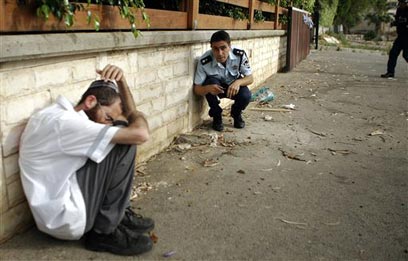 Sderot taxi drivers protest government's inaction
Drivers slowly make their way from rocket-battered city to cabinet meeting in Jerusalem, say 'if government fails to do something, we will start doing something'
Shmulik Hadad
Dozens of business owners and taxi drivers gathered in the center of Sderot on Sunday afternoon, carrying signs protesting the government's failure to deal with the ongoing rocket fire.
The protestors plan to slowly drive from the southern town to the cabinet meeting in Jerusalem.
Foreign Support
US tourist visits Sderot to support residents left behind / Yael Branovsky
James Greenberg, an 85-year-old American Jew visiting Tel Aviv, travels down to battered city after hearing of situation on the news; says "all Israelis and tourists should visit Sderot more often"
"Our children must not be abandoned" and "There is no security in Sderot" are only some of the slogans that could be seen on the cars making their way to the capital.
This is the first organized demonstration in Sderot since the start of the current escalation, after failed attempts to organize a demonstration for fear the crowds would be hit by rockets.
'Color Red' alert system activated (Photo: AP)
Aharon Orian, manager of the local taxi station, cannot remember such a difficult situation.
"It's impossible. The government must do something. If they don’t do something, we will do start doing something," he told Ynet.
According to Ya'akov Shoshani, another taxi driver, "There is only one thing we haven’t heard yet: A government commitment to stop the rocket fire at any cost. Instead, we hear that they want to give Abu Mazen (Palestinian President Mahmoud Abbas) rifles again. The Palestinians are sitting there in Beit Hanoun and laughing at us."
Roi Mandel contributed to the report
MEANWHILE..... ARABS THREATEN SLAUGHTER IF IDF RETALIATES:
Female suicide bombers 'eagerly await' IDF soldiers
(VIDEO) Islamic Jihad warns Israel of 'surprises' should IDF invade Gaza Strip; dozens of female suicide bombers eager to blow themselves up, take soldiers with them Ali Waked Published: 05.20.07, 11:37 / Israel News
VIDEO - Islamic Jihad's military branch released a warning Sunday morning that dozens of women were ready to defend the Palestinian people if the IDF invaded the Gaza Strip.
The organization said it was fully prepared to retaliate "if the Zionist enemy committed foolish acts against Palestinians in the Strip."
"The enemy's threat to act in the Strip will not be fruitful and their goals will not be achieved. The Palestinian organizations are at high alert to handle a Zionist attack in the Strip," the statement said.
| Video clip released by the Islamic Jihad |
Islamic Jihad also released a video clip in which a high-ranking Jihad official said that his organization has prepared dozens of female suicide bombers who were eager to blow themselves up along with IDF infantry troops if if Israel was to enter and operate in the Strip.
She said that she was jealous of the suicide bombers who "received Allah's help in fulfilling successful missions, and we wish to follow in their footsteps. The enemy will be defeated if it invades the Strip."
An Islamic Jihad official told Ynet that the army of suicide bombers was only one of the "surprises" prepared for Israel, along with heavy barrages of longer-range rockets and suicide attacks inside Israel. "We have said, and we will repeat – an invasion into the Gaza Strip will be no walk in the park."
Over the last few years, especially since the Al-Aqsa intifada, terrorist organizations have started to use women on several occasions.
In 2004, Hanadi Jaradat, a 29-year-old lawyer from Jenin, detonated an explosive device in the center of the crowded Maxim restaurant in Haifa on a Saturday afternoon, killing 21 Israelis.
----------------------------------------------------------------------------------------------------------
What are we waiting for???? Surrendering Gaza to the terrorists was a blunder, everyone knows that. Just as predicted, attacks against Israeli civilians have increased as the palestinian terrorists use surrendered Israeli land to murder our children. There is only one solution.... "They Must Go! They Must Go! They Must Go! " (Blogmaster)
SDEROT UNDER BLITZ OF ROCKET ATTACKS - ISRAELI GOVERNMENT MUST ACT SWIFTLY
Five More Kassams at Sderot

(IsraelNN.com)
At least six rockets hit the city over the Sabbath; close to 20 rockets and mortar shells were fired at the western Negev area, causing injuries and damage.
Residents Forced to Return?
Dozens of Sderot residents put up in hotels across Israel were surprised on Saturday night by letters informing them that they would have to leave their rooms by Sunday morning. The residents were given a free vacation from their rocket-pocked homes by Russian-Israeli billionaire Arcadi Gaydamak, and were under the impression they would be allowed to stay in the hotels until after the Shavuot festival, which begins Tuesday evening.
Officials explained to the Maariv daily newspaper that the letters were issued since there are 800 other families waiting for vacations and 200 waiting to be evacuated from the city.
Residents expressed fear about returning home to Sderot, explaining that several rockets had fallen during their absence. Some said that rockets had landed near their homes. “We’re not going back until there’s quiet and our children’s lives aren’t in danger,” one mother told Maariv.
Sderot Wants Declaration of Emergency
The Sderot municipality said it would ask the government to declare a state of emergency in the city and surrounding towns Sunday. The decision was made in a meeting on Saturday between Sderot Mayor Eli Moyal, city officials, and security officials.
Sources in the government said that Sderot and other towns in the western Negev could be granted the sub-emergency status of border towns near a combat zone, the same status granted to cities along the border with Lebanon. The new status would affect government aid to the area, and could grant residents various financial incentives.
Since last Tuesday (May 15), over 125 Kassam rockets have been launched at the western Negev - 40 over the weekend. 10 people were lightly wounded in the weekend attacks - seven suffered from shock.
Bereaved Father Helps Sderot
Shomron resident Boaz Shabo, who lost his wife and three of his children in a terrorist attack in the Shomron town of Itamar in 2002, has decided to spend his days in Sderot helping the embattled community face dozens of rocket attacks.
Shabo explained that his volunteer service helps him to deal with his grief, and that his children support his efforts. He also volunteered in the north during the Second Lebanon War, and says he goes wherever his help is most needed.
Shabo has been a volunteer paramedic with Magen David Adom for many years. He joins MDA crews in responding to rocket attacks and treating wounded at the sites. When the other paramedics leave, Shabo remains, in case wounded people suffering from shock have hidden near the scene of the attack, as has happened in some terrorist bombings.

Mofaz: Kill Terror Leaders, Fast
by Gil Ronen
(IsraelNN.com) Minister of Transportation Shaul Mofaz says the IDF needs to start eliminating the terror groups' leaders, as it did when he was Minister of Defense.
In an interview on Channel 2 Saturday, Mofaz said: "We have some good starts here, there are steps being taken against the terror masters, [but] we need to reach the leadership, quickly. Every one who has his hands in terrorism needs to be on the crosshairs of the State of Israel."
The municipality of the rocket-ravaged town of Sderot announced that Mofaz was the only person who has a record of operating against the terror rockets and endorsed him as its preferred candidate for Minister of Defense. Sderot invited Mofaz to a defense discussion scheduled to take place in the town Sunday morning. He will also tour some of the spots hit by rockets recently.
Mofaz was Minister of Defense during the "Disengagement" from Gaza and the destruction of Gush Katif. The rockets Sderot is now suffering from are being launched from the territory Israel evacuated at that time.
The Sderot municipality's spokesman, Yossi Cohen, said it is hard to understand why the government is continuing its policy of restraint even after several houses were directly hit last week and one of the town's residents was badly injured.
Terror rocket attacks by Gaza terrorists continued for Saturday. The "Color Red" warning system was activated three times during the day.
By 9 p.m. Saturday night, a dozen terror rockets and 5 mortar shells had hit areas in the Negev, and the rockets were still falling. Six of the rockets fell in Sderot. One rocket caused considerable damage to a factory in Sderot's industrial zone and another burst a water pipe, halting the flow of water to some of the city's residents for several hours.
By 9 p.m. Saturday night, a dozen terror rockets and 5 mortar shells had hit areas in the Negev
One person was lightly injured by shrapnel when a rocket hit a house in Neve Eshkol, and four others suffered from shock in the attack. All were taken to Barzilai Hospital in Ashkelon for treatment. Three other people in Zohar, a "moshav" (agricultural community) near Gaza, were also treated for shock when a rocket hit near them. Even the dead had no quiet Saturday: terrorists fired a rocket at the cemetery in Kfar Maimon, and another was fired later at the Sderot cemetery. No damage was reported in either attack.
The five mortar shells fell near the security fence, in the vicinity of Sufa. No casualties or damage have been reported.
Two IDF soldiers whose unit was operating on the border with Gaza late Saturday were injured by an anti-tank missile fired by Gaza terrorists. The soldiers were taken to Barzilai Hospital in Ashkelon with moderate to light injuries. Meanwhile, three Gaza terrorists were killed and five wounded when IAF attacked a terrorist cell preparing to fire rockets at Israeli targets.
In an interview with Israel Radio, Defense Minister Amir Peretz said that the IDF would continue to attack Hamas targets in order to pressure Gaza residents to restrain the rocket attacks on Israel. "The Palestinians need to understand that Hamas is leading them into disaster, a real disaster," Peretz said. "It is our intention to act against Hamas."


"Note: Talk is cheap and the hot air from the Government could fill a billion balloons. If the Government cannot defend our cities and towns, then perhaps other measures to secure our communities and protect our citizens is warranted." Blogmaster

Gas Station, Private House Hit by Rockets in Sderot
by Hana Levi Julian
(IsraelNN.com) Sderot residents awakened to the scream of Color Red alert sirens Friday morning, announcing that school would have to be closed for a third day.
Nine rockets were fired at Sderot and other western Negev communities Friday morning, five exploding in Sderot and the other three in other communities by mid-morning.
One of the rockets exploded in a Sderot gas station in town, lightly wounding one person. Another scored a direct hit on a private home. Four people suffered shock in the attack. Three other residents were hit by a spray of shrapnel by a different Kasssam rocket and rushed to Ashkelon’s Barzilai Hospital.
Three rockets landed in open areas around the town, two on the Sapir College campus and one near the Sderot cemetery. No one was injured and no damage was caused by these attacks.
The rocket attacks forced Sderot officials to cancel school for a third day in light of the security conditions, despite Mayor Eli Moyal’s insistence Thursday that classes would resume.
Two of the missiles landed in areas south of Ashkelon and another one exploded in the Sha’ar HaNegev Regional Council area, touching off a brush fire.
One rocket exploded in an area next to Kfar Maimon -- the first time in a year that a rocket has landed so close to Netivot.
Two Pensioners’ party ministers, Health Minister Yaakov Ben Izri and Rafi Eitan, Minister of Pensioner Affairs arrived a short time ago arrived in Sderot a short time ago to show their support and solidarity with the traumatized community.
Eitan said Thursday that he would work with the Eshel organization to send approximately 2,000 pensioners from Sderot to a weekend vacation on Friday. Pensioners will stay for free at hotels in Jerusalem and near the Dead Sea. The vacations will cost approximately two million shekels.
The Tourism Association and local hotels in Eilat have offered to give 250 residents of Sderot three free days in Eilat hotels, with meals included. The Telran manpower company is offering 40 job positions to Sderot vacationers.
After Sderot, Ben-Yizri will be visiting the Barzilai Hospital in Ashkelon, where most regional rocket attack victims have been treated.

Rocket Fire Completes a Torah Scroll Ceremony in Sderot
by Hana Levi Julian
(IsraelNN.com) Hamas terrorists did not succeed late Thursday night to prevent a Torah scroll from reaching its ark in a Sderot synagogue, but it was a close contest.
A rocket fired from Gaza slammed into a synagogue just minutes after some 300 celebrants had left after the hours-long ceremony bringing the Torah scroll to its new home.
The 3-rocket attack punctuated a day in which more than 20 Kassams were fired at the western Negev by the Hamas terrorists who rule the Palestinian Authority government.
The house of prayer was damaged and those who had remained to tidy up after the joyful dancing, left the synagogue in tears, many suffering shock.
Some pointed to the Divine protection that had shielded the hundreds of dancing and singing Jews who had left the building just moments before. “If people had not gone home,” said Moti Shitrit,” many would have been killed. G-d rescued us.” Mr. Shitrit was one of those who had stayed to clean up.
The barrage of rocket fire also missed Prime Minister Ehud Olmert, who had arrived with Defense Minister Amir Peretz shortly before in an unannounced visit to the town.
Bodyguards and security people hustled the surprised prime minister into one of the shelters he had ostensibly come to inspect, as the Color Red missile alert system wailed its warning.
The entourage, which included Kadima MK Otniel Schneller, visited one of the houses that sustained a direct hit by a rocket earlier in the day, met with Sderot Mayor Eli Moyal, and had coffee at Peretz’s home with his wife and two children.
"It was important for me to come here tonight, so you would know you are not alone," the prime minister told Sderot residents during the visit. "We all feel your pain and understand your anxiety. The government will do everything in its power for your and the country's security," he assured them.
One irate resident tried to gain access to the defense minister’s home as the entourage chatted inside. “The prime minister is a coward,” shouted Aryeh Cohen. “You came like a thief in the night with all your bodyguards. I want to talk to you.”
Nor did Mr. Cohen spare the defense minister in his outrage. “Peretz is a bigger coward than you are. He’s living in a fortified house, while we don’t even have shelters!”
15 May 2007


11 May 2007

Subscribe to:
Posts (Atom)
Israel Security Agency

Shin Bet - Protecting Israel's Security 24/7






























 While doing IDF (Israel Defence Forces) reserve duty on a mountain overlooking the